Monday, February 08, 2010

Offline Until 2/15

Friday, February 05, 2010

Fidelity Coup and F&O

It looked like Schwab had a good thing going when they announced their 8 commission free ETFs in December and then Fidelity comes and blows the doors off with a portfolio of 25 commission free offerings. These aren't newbie low volume ETFs, but tried and true ishares with high volume kickers like EEM and IWM featuring huge open interest and penny option spreads. Long time Schwab loyalists like myself are now faced with a simple business decision and the course of action seems pretty clear. With Fidelity's variety of ETFs it's possible to construct a relatively simple rotational model, both long and short term, using the AGG and TIP as hedges. If Fidelity would just throw a technology ETF, a commodity based ETF and few inverse ETFs into the mix they'd soon have the only game in town.

I've mentioned some of the free e-magazines before but here's a refresher on F&O, a product of the folks that publish Active Trader. This month's issue has some intriguing ideas, including a different spin on the butterfly setup and a simple Keltner channel system (for investor types).
If you visit the site you can also download the January issue, which contains a few more nuggets including the slingshot strangle, which looks like a timely strategy.
Although the title refers to futures and options, any trader worth his salt knows that many of these tactics and setups work effectively with stocks and ETFs.

Thursday, February 04, 2010

Project Z and the Qs

This is the Project Z outlook for the Qs as of Wednesday's close. Based on the Project Z parameters the Qs are quickly approaching overbought conditions relative to overall market volatility. We have multiple exit conditions and trailing stops in place to limit risk exposure and retain any gains and I expect the current open position to be liquidated today or Friday. The current trade had a double entry (second entry at yellow dot) and is at a break even point after a 5 day duration on the initial entry while holding a .63 gain on the second entry .


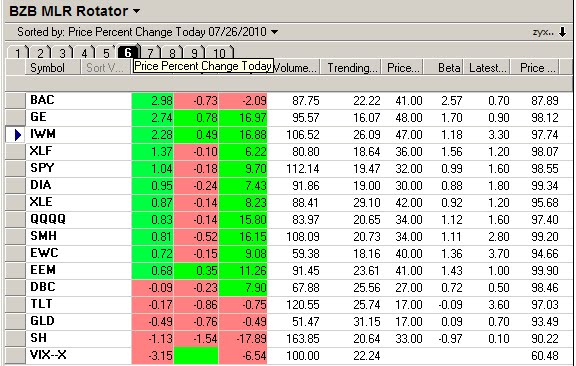
Below, the daily rotation model using a 6 period moving linear regression has now pumped the Qs into slot #1. I've exposed a previously hidden metrics column (in yellow) which shows the % change in price for the day. This is the metric that I use as opposed to absolute price, which really provides no basis for evaluating relative performance. While the Qs lagged yesterday, they made up the difference (and more) today.


Wednesday, February 03, 2010

Rotation Variations

Some impressive strength and breadth in the markets over the past 2 days, although my Project Z indicator has now penetrated into overbought territory on virtually all the major indices.
Just for comparison sake I ran the 6 period moving linear regression sort on both 1 and 2 day bars. Of note is the concurrent low rankings of VXX, SH, TLT and the Qs.
Perhaps surprisingly, the SPY is ranked #1 on the daily sort with the DIA close behind. A more typical scenario is momentum leadership held by the higher beta indices. The sort results reflect SPY performance Tuesday: up 1.3%, with the IWM & DIA up 1% and the Qs up .7%.
As an aside, I personally avoid trading the DIA as it's composed of only 30 stocks, many of which are heavily gamed on a daily basis by large prop shops and the open and close in DIA components can be interesting, to say the least. In addition, a quick look at volume distribution among the DIA components will show that the hands down leaders every day are often INTC and MSFT, a fact that tends to skew DIA performance in line with the SMH. That's not necessarily a trading handicap, but it does help to be aware of the alignment.

Some major changes to the blog format and content are in the works that I hope will both enhance the functional utility of the site for my readers and at the same time allow me more time to focus on actual trading. Fellow bloggers appreciate the amount of research and preparation that goes into these posts. Unfortunately I've come to the realization that such a time commitment is compromising the amount of attention that I can devote to trading, which is what keeps the lights on and Mrs Barnes happy. The result will be a more streamlined and consistent blog content that will more closely reflect actual trading decisions that I'm implementing.
The new format should be operational by the end of the month.

Tuesday, February 02, 2010

Rotator and EEM Situation

Market dynamics changed quickly Monday as we avoided an ominous collapse that looked like a good bet on Friday. The TLT position got washed out right from the get go and the interesting development was that slots 3 and 4 on the rotation sort (GLD and the Qs) proved solid money makers.
I now realize that one problem with the Rotation model is that the inverse positions are limited to VXX and TLT and I probably need to pump up the portfolio of short side candidates to balance the bullish side of the list. I'm also going to crank down the time frame from a 3 day to a 2 day bar in order to catch momentum turnarounds a bit sooner.
The current sort is shown above.
As an aside, anyone wishing to dig deeper into the somewhat arcane nuances of the VXX should check out Bill Luby's (sometimes known as Mr. VIX-it) exploration of this complex ETN.

The EEM Situation discussed last week along with the butterfly setup is developing nicely based on the Project Z algorithm. The position is currently on day 3 of a BUY signal and we have 9 days remaining before a fixed bar exit closes the position. A momentum excursion into target resistance levels at 1.8 will also cause the trade to exit. The algorithm currently is displaying a value of 1.00 so I'm expecting this trade to close well before the fixed bar date.

Monday, February 01, 2010

Monday VIXology & Rotator Update

This week's charts are displayed on 3 day bars as this is the time increment I've adopted for looking at the Telechart Rotator model.
The VIX has now risen to the upper LR30 channel band and appears to be resting there while contemplating the next move. All the majors are showing lower LR 30 channel "kiss-offs" with the Qs displaying some reluctance to capitulate.
Keep in mind these are 3 day bars and on daily bars the Qs situation looks a LOT worse . . in fact, for the week the Qs showed above median weakness.

This is an update of the Telechart Rotator using a 6 period moving linear regression, a study that's resident in Telechart and offers instant sorting capability, based on a variety of metrics, for your custom built watchlist.
Last Friday's selection of TLT as the best momo candidate was suspect at the time. but ultimately turned out to be the best choice for the week. While TLT only gained .34% for the week, compared to the substantial losses of the majors (SPY -1.67%, IWM -2.62%, Qs -3.1%,
and EEM -3.66%), the TLT proven to be a safe haven.
Looking forward this week, TLT still has slot #2, with #1 being reserved for VXX . . an ETN that has it's own market dynamic idiosyncrasies that do not necessarily conform to standard indicators. Finally, I would be resmiss if I didn't mention my Clueless trading buddy who also uses the Telechart program to define his own version of a rotation model using a MoneyStream Surge. The Clueless One frequently expounds on various nuances of these setups and always has a few nuggets to share. You won't be bored.

Friday, January 29, 2010

EEM Situation

This is a continuation of yesterday's post and explores 4 different butterfly scenarios using EEM puts to create a debit spread.
Scenarios 1 & 2 are based on a 2 strike spacing while 3 & 4 are based on 3 strike spacing. The thing I like about butterflies is that risk is capped (so is potential gain) and it's often best to exit these positions (or at least of portion of the position) once 50% of the target returns have been achieved. That decision, of course, is premised on the proximity of the current price relative to the maximum gain target and it's worth monitoring these positions intraday in order to capture potential profit pop surges.
The other thing I like about the butterfly is that you can skew the spread to neutral, bullish or bearish, depending on the target strike. Increasing strike spacing can produce a very wide opportunity window, while a narrower spacing decreases the net debit and typically increases the max risk/reward ratio . . in this case (scenario #1) 1.64/-.36 and opposed to scenario #3 . . 2.22/-.78. I'm currently inclined towards scenarios 1 & 3, especially after Thursdays drop back down to $ 38.41 . . close to the $38.65 price which produced a BUY signal on Wednesday.